

KEY TAKEAWAYS
- Markup is added to cost. Margin is profit as a share of the selling price.
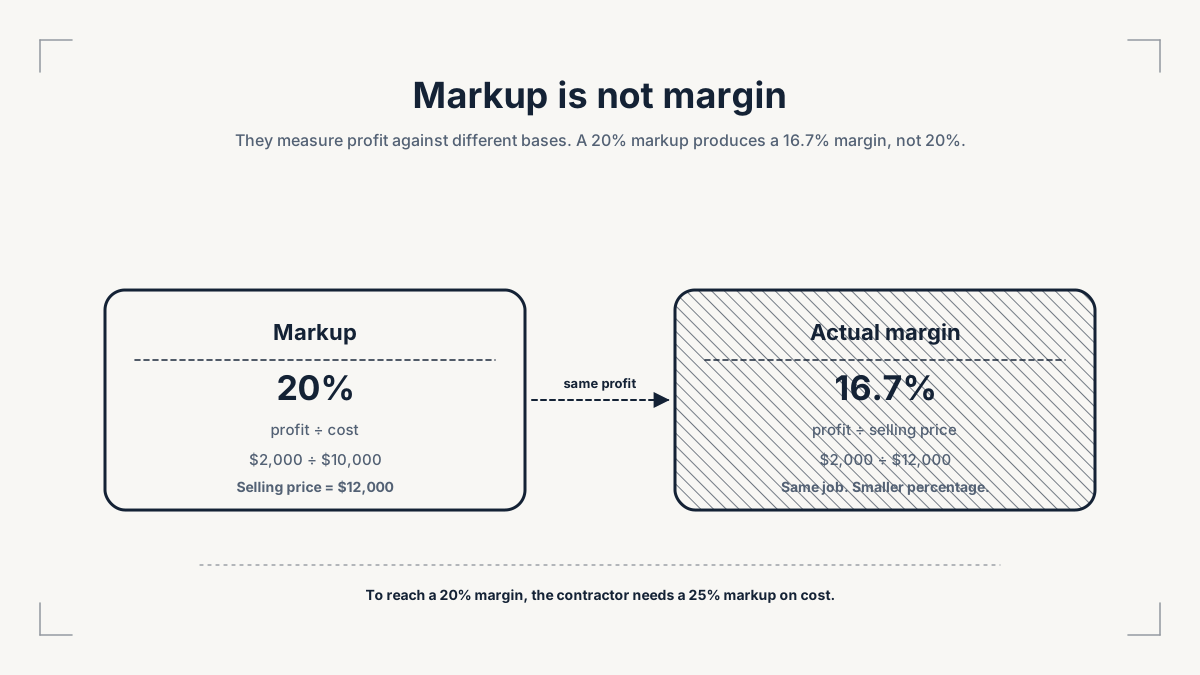
- A 20% markup does not create a 20% margin. On a $10,000 cost base, 20% markup creates a $12,000 price and a 16.7% margin.
- Contractors underprice when they add markup before knowing overhead, labor burden, owner pay, and delivery risk.
- Owner pay is not profit. If the owner estimates, sells, supervises, fixes problems, or manages the client, that time must be priced.
- The walk-away floor is the internal number that tells a contractor whether to quote, re-scope, or decline a job.
DEFINITION
Contractor markup is the percentage added to cost to arrive at a selling price. Contractor margin is the share of the final selling price left after costs are paid. They are related, but they are not the same number.
That distinction sounds technical. In a home improvement business, it is survival math.
A contractor can add a markup, win the job, finish the job, and still fail to make real profit. The usual reason is not that the contractor forgot arithmetic. It is that the markup was applied to the wrong base. It did not recover labor burden, overhead, owner pay, risk, warranty exposure, rework, sales time, estimating time, or project-management time.
Forja's view is direct: a markup is not a pricing strategy. It is only one input. A serious contractor needs a walk-away floor before deciding what client-facing price is viable.
That floor should answer a harder question than "what percentage should I add?"
It should answer:
- What does this job directly cost?
- What labor burden and supervision does it require?
- What overhead must the business recover?
- What owner time must be paid before profit?
- What risk reserve does the job need?
- What profit must remain after all of that?
That is why the walk-away floor belongs before the client-facing quote. It forces the contractor to price the business required to deliver the job, not only the visible labor and materials.
What is the difference between contractor markup and margin?
Markup is calculated against cost.
Margin is calculated against the final selling price.
That is the whole difference, but it changes every quote.
If a job costs $10,000 and the contractor adds a 20% markup, the price becomes $12,000. The contractor did not make a 20% margin. The margin is $2,000 divided by $12,000, which is 16.7%.
KEY INSIGHT
Markup = profit / cost Margin = profit / selling price
Procore's construction markup and profit margin guide explains the same distinction: markup is the amount added to cost, while profit margin measures profit against revenue. Procore's support page also shows why a 30% margin requires a higher markup than 30%.
The problem is not that contractors cannot learn the formula. The problem is that many contractors use markup as a substitute for pricing discipline.
A markup does not tell the contractor whether:
- the owner was paid,
- overhead was recovered,
- supervision was priced,
- labor burden was included,
- rework was allowed for,
- the warranty exposure was sensible,
- the job damaged capacity,
- or the client experience could be delivered at the promised standard.
That is why a markup can look professional on a spreadsheet and still produce a weak business.
One contractor asked a common version of the problem in a contractor pricing discussion: "How much to should I markup my labor, materials and subcontractors?!?!?" The question is understandable, but incomplete. The better question is: what must this business recover before profit can honestly be counted?
Why does a 20% markup not create a 20% margin?
The easiest way to see the problem is to run the numbers.
$10,000
10%
$11,000
$1,000
9.1%
$10,000
20%
$12,000
$2,000
16.7%
$10,000
25%
$12,500
$2,500
20.0%
$10,000
33.3%
$13,330
$3,330
25.0%
$10,000
50%
$15,000
$5,000
33.3%
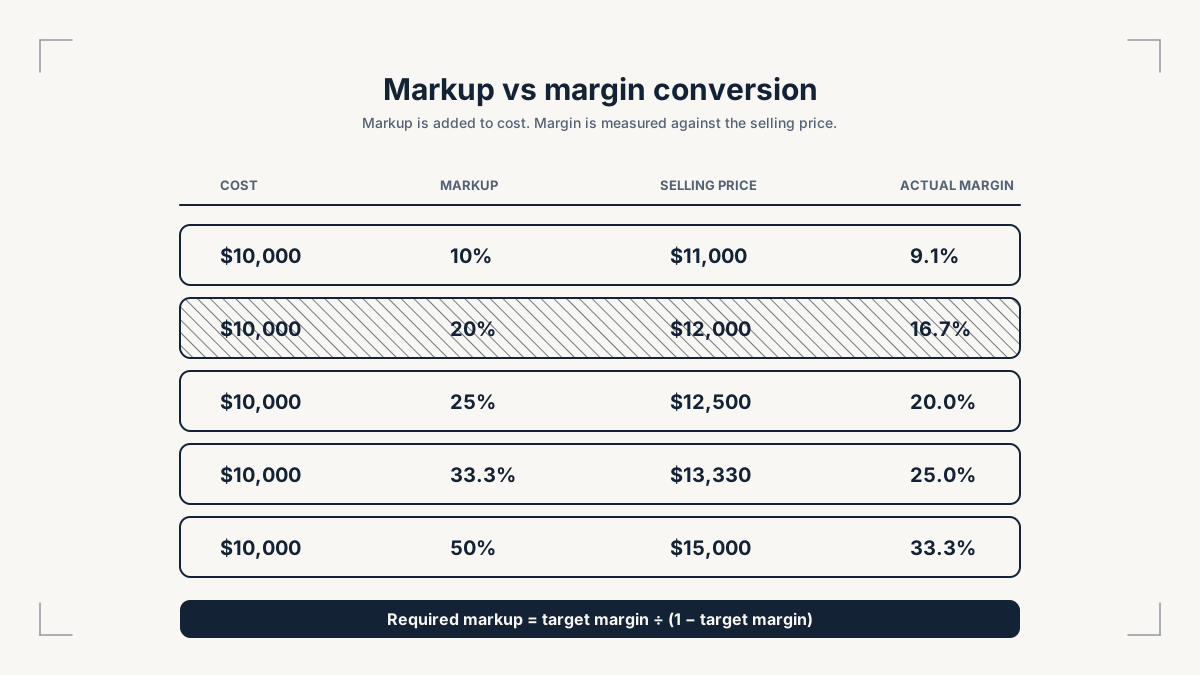
If the contractor wants a 20% margin, the markup cannot be 20%. The required markup is:
KEY INSIGHT
Required markup = target margin / (1 - target margin)
For a 20% margin:
KEY INSIGHT
0.20 / (1 - 0.20) = 0.25
So the contractor needs a 25% markup on cost to produce a 20% margin before any missing overhead or owner-pay problem is considered.
That last phrase matters: before any missing overhead or owner-pay problem is considered.
If the cost base includes only visible labor and materials, the calculation is still wrong. The markup is being applied to a number that excludes part of the business. That is how contractors stay busy and still feel underpaid. The work may be selling. The business may still be subsidizing the client.
BuildingAdvisor's pricing guide makes the same point from a contractor finance angle: overhead and profit must be included in job pricing, and margin is not the same as markup.
In the field, this confusion shows up as a familiar pattern:
- the quote covers materials,
- the quote covers crew labor,
- the quote includes a markup,
- the contractor wins the job,
- the owner spends evenings estimating, calling, supervising, buying, chasing, and correcting,
- then the business calls the leftover cash "profit."
That is not profit. That is often unpaid owner labor wearing the wrong label.
What does contractor overhead actually include?
Overhead is the cost of keeping the business capable of delivering work.
It is not only office rent. It is not only admin. It is not something that can be left to "whatever is left" at the end of the month.
Investopedia defines overhead rate as a way to allocate indirect costs to production or service delivery. In a contractor business, those indirect costs are not abstract. They are the trucks, tools, admin, estimating, software, insurance, phones, rent, accounting, marketing, and management time that make delivery possible.
For a home improvement contractor, overhead often includes:
Admin
bookkeeping, scheduling, client calls, document handling
Treated as free owner time
Vehicles and tools
insurance, fuel, maintenance, depreciation, storage
Buried in personal spending or spread unevenly
Sales and estimating
site visits, measuring, proposals, follow-up
Given away to win work
Software and finance
CRM, estimating, accounting, payment processing
Underfunded, duct-taped, or ignored
Management
supervision, procurement, problem-solving, quality control
Confused with hands-on labor
Compliance and risk
insurance, safety, warranty, legal, tax support
Added only after something goes wrong
This is where many contractors lose the plot. They do not simply forget one line item. They underbuild the operating system behind the job.
In one contractor discussion on markup and profit, an operator explained that overhead included office labor, rent, insurance, benefits, vehicles, and maintenance before net profit could be understood. Another construction discussion on profit margins noted that marketing, tech, insurance, legal, bad debt, vehicle costs, and travel can all sit behind the apparent spread between cost and price.
That field evidence matters because it shows the real problem. Many contractors are not choosing between "high markup" and "low markup." They are choosing between a complete cost base and an incomplete one.
If the quote does not recover overhead, the overhead does not disappear. It comes out of owner pay, quality, safety, responsiveness, warranty capacity, or the company's survival margin.
Why is owner pay separate from profit?
Owner pay is one of the most misread numbers in small contractor pricing.
If the owner performs real work, the business must price that work.
That work may include:
- estimating,
- site visits,
- measuring,
- procurement,
- sales calls,
- supervision,
- crew coordination,
- quality control,
- client communication,
- problem-solving,
- rework management,
- and follow-up after completion.
If another person had to do those tasks, the business would pay them. When the owner does them, the cost does not become free. It becomes easier to hide.
This is why owner pay and profit must be separated.
Owner pay compensates a person for work performed.
Company profit is the return left after direct costs, overhead, labor burden, owner pay, and risk have been covered.
One commenter in a contractor markup discussion put the issue bluntly: profit figures can be "really skewed by owner pay." That is exactly the issue. A contractor can look profitable only because the owner did not pay themselves properly. The company may not be strong. It may simply be leaning on the founder's unpaid labor.
Forja's owner-pay test is simple:
“Would the job still look profitable if the owner had to hire someone else to perform their role?”
Forja Insights
If the answer is no, the business has not priced the work properly.
This matters especially for owner-operators and growing remodelers. In the early stage, the owner may do everything. That is normal. But the price still has to acknowledge the work. Otherwise, the company cannot hire, delegate, scale, or survive the owner's absence.
The point is not that every small contractor must immediately draw a corporate salary. The point is that the price must not depend on pretending the owner's time has no value.
What is the Forja Walk-Away Floor?
The walk-away floor is the internal minimum below which a contractor should re-scope, renegotiate, or decline the job.
It is not necessarily the final price shown to the client.
It is the number that protects the business from buying work.
KEY INSIGHT
Forja Walk-Away Floor = Direct job cost + Labor burden + Job-level overhead + Business overhead recovery + Owner pay + Risk reserve + Target profit
The walk-away floor is not only a formula. It is a discipline.
If the client-facing price cannot sit above that floor, the contractor has three serious options:
- Re-scope the work.
- Change the pricing model.
- Walk away.
What the contractor should not do is erase owner pay, reduce supervision, ignore warranty risk, or hope the job goes perfectly.
Here is a simple example.
Assume a mid-size renovation has direct job costs of $15,500.
Direct job cost (including burdened labor)
$15,500
$15,500
Business overhead recovery
$3,100
$18,600
Owner estimating and management time
$1,500
$20,100
Risk reserve
$1,500
$21,600
Walk-away floor (÷ 0.85 for 15% margin)
$25,412
This example groups burdened labor inside the direct job cost. In your own cost build, price labor burden separately: wages, payroll burden, travel, setup, supervision, and rework allowance. Add it as a distinct line before the overhead allocation step. The formula does not change; only which costs sit in which bucket.
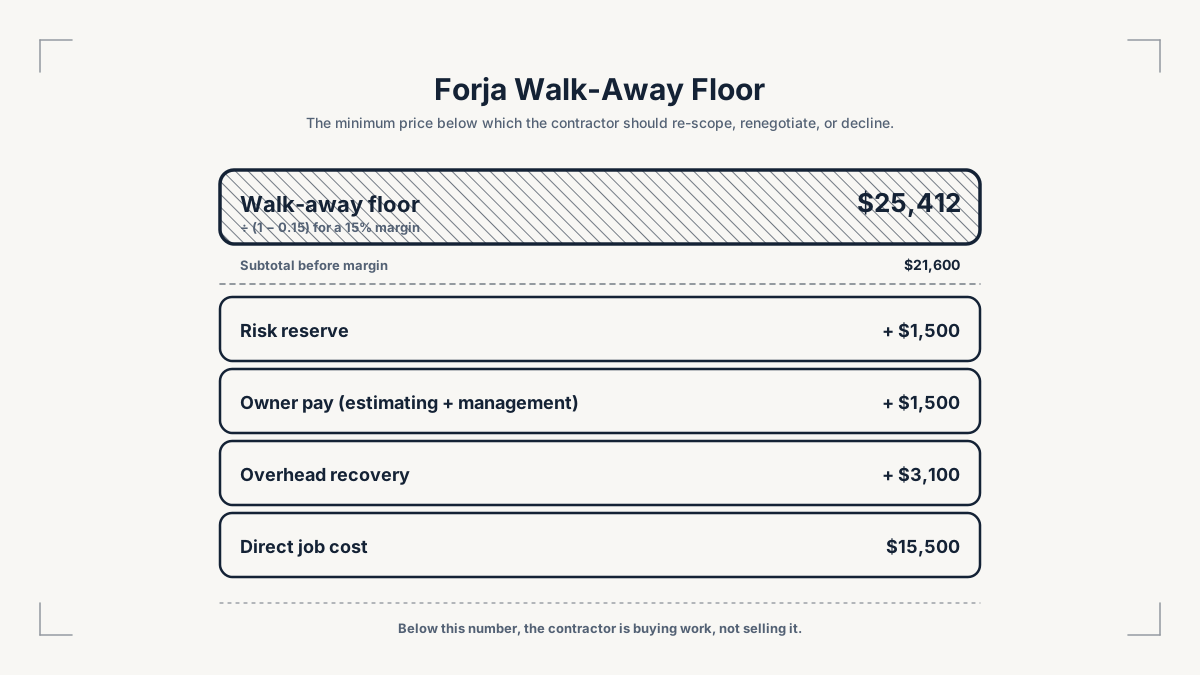
In this example, the walk-away floor is $25,412 before any client-facing positioning or market adjustment. It aligns with the worked example in the contractor pricing strategy guide.
That does not mean the contractor must show the client a line-by-line internal cost build. It means the contractor should not accept a price below $25,412 unless the scope changes.
If the client has a $22,000 budget, the contractor's job is not to "sharpen the pencil" until the business bleeds. The contractor's job is to change the scope, change the assumptions, change the timeline, change the materials, or decline.
In one construction-manager discussion about profit and overhead, a commenter warned that a standard markup on everything can still leave a contractor "in the red or scraping by longterm." That is the walk-away floor problem in plain language. The percentage is not enough. The contractor has to know the floor.
What cost layers are most often missing before profit is counted?
The most dangerous missing layers are labor burden and risk reserve.
That does not mean overhead is unimportant. It means the labor and risk problems are easier to underestimate because they hide inside the job.
Labor burden is not just hourly wage. It can include:
- payroll taxes,
- workers' compensation,
- benefits,
- travel time,
- setup time,
- cleanup time,
- disposal time,
- supervision,
- helper time,
- training,
- idle time,
- rework,
- and coordination between trades.
Risk reserve is the allowance for what can reasonably go wrong. In home improvement, risk is not theoretical. It includes:
- hidden site conditions,
- weather,
- access problems,
- material price changes,
- client decisions,
- late selections,
- warranty callbacks,
- safety issues,
- permit delays,
- design ambiguity,
- and scope changes.
This is where a contractor can add a markup and still underprice the job. The markup may cover the visible work, but not the conditions that make the work hard to deliver.
In custom interior design and fit-out work, this becomes even more important. Two projects can look similar from the outside and behave completely differently once selections, access, site conditions, client expectations, and finish standards enter the job.
A contractor who prices both jobs with the same shortcut is not being efficient. They are ignoring risk.
How should a contractor decide whether to quote, re-scope, or walk away?
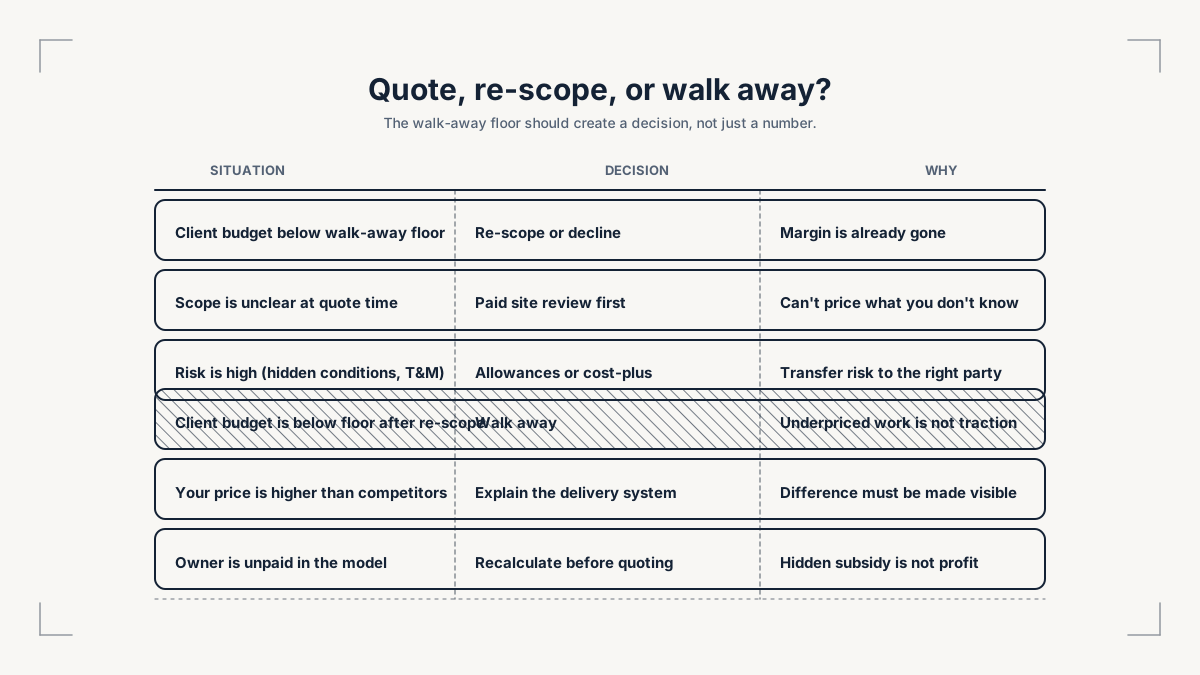
The walk-away floor should create a decision.
It should not sit in a spreadsheet while the contractor negotiates against themselves.
Client budget is below the walk-away floor
Re-scope or decline
Scope is unclear
Charge for site review, measuring, or design before a final quote
Risk is high
Use allowances, time and materials, cost-plus, or change-order terms
Client wants premium delivery at budget pricing
Reduce scope or walk away
Price is higher than competitors
Explain delivery system, risk controls, supervision, communication, and warranty
The owner is unpaid in the model
Recalculate before quoting
This is not about being expensive for the sake of being expensive.
It is about refusing to sell work the business cannot deliver profitably.
If the client cannot afford the full scope, the answer may be a smaller scope, a phased project, different materials, a simpler finish level, a longer timeline, or a paid planning stage before final pricing. The answer should not be silent underpricing.
For complex work, the contractor may need to separate:
- site review,
- design or space planning,
- technical scope,
- allowances,
- and delivery quote.
That protects both sides. The client gets a clearer decision. The contractor avoids pretending to know a final price before the work is understood.
How do you explain a higher price without showing every internal line item?
A contractor does not need to expose every internal cost to the client.
But a contractor does need to explain what the price protects.
The client does not need a lecture on overhead. The client needs confidence that the contractor has understood the work and can deliver without chaos.
Instead of saying:
“"My price is higher because my overhead is higher."”
Forja Insights
Say:
“"This price includes site protection, supervision, documented communication, material price validity, a change-order process, and warranty support. Those are the parts that keep the project controlled after work begins."”
Forja Insights
Instead of saying:
“"My labor costs more."”
Forja Insights
Say:
“"This quote allows for setup, cleanup, supervision, and proper sequencing. Those are the items that reduce rework and keep the finish consistent."”
Forja Insights
Instead of saying:
“"I cannot do it cheaper."”
Forja Insights
Say:
“"At that budget, I would need to reduce the scope or change the specification. I do not want to promise a level of delivery that the price cannot support."”
Forja Insights
This is where positioning and pricing meet.
If the contractor cannot explain why the price is higher, the problem is not only the number. The problem is the proposal.
Good pricing makes the delivery system visible. It shows the client what they are buying beyond materials and labor:
- clarity,
- risk control,
- supervision,
- communication,
- warranty discipline,
- schedule discipline,
- and accountability.
That is also why low quotes can be dangerous. They may remove the very systems that protect the client from delay, rework, disputes, and disappointment.
What margin target should a contractor use?
There is no universal margin target that works across every trade, market, and project type.
Benchmarks are useful, but they are not instructions.
In April 2026, NAHB reported that residential remodelers in its latest Cost of Doing Business Study averaged a 6.3% net profit margin and a 29.9% gross profit margin in 2024. That gives the industry context. It does not tell a custom fit-out operator, roofing crew, remodeling firm, or owner-operator what a specific job should earn.
The better question is more specific:
“What margin does this business need after cost, overhead, owner pay, and risk?”
Forja Insights
A routine repair with known scope may carry lower uncertainty. A premium fit-out with selections, site constraints, client decisions, and finish risk needs a different floor, a different margin target, and sometimes a different pricing model.
Margin targets should also change when the pricing model changes. A fixed price for well-scoped repeat work, a time-and-materials arrangement for unknown conditions, and a paid design stage for complex fit-out work carry different risk. Software can help track those differences only after the contractor knows what the price must recover.
Why does this matter to Forja contestants, sponsors, and judges?
Forja is an execution-first competition. Contestants have to prove they can Design → Build → Release, and a paying customer is part of that proof.
But a paying customer is not enough.
Revenue is not proof of traction if the job was underpriced.
A contestant who wins work by ignoring overhead, owner pay, labor burden, risk, or delivery quality may have demand. They do not yet have a durable business model.
That matters to judges because pricing reveals founder judgment.
It matters to sponsors because serious partners want to reach operators who understand their business, not only operators chasing revenue.
It matters to investors because margin discipline shows whether demand can become a company.
And it matters to contractors because underpricing eventually appears somewhere:
- in owner exhaustion,
- in unpaid admin,
- in weak supervision,
- in rushed work,
- in poor communication,
- in warranty problems,
- in cash-flow stress,
- or in client disappointment.
The goal is not to charge the highest possible price.
The goal is to quote work that can be delivered with the quality, supervision, communication, safety, and profit the business promised.
That starts with knowing the difference between markup and margin. It becomes useful only when the contractor also knows the walk-away floor.
FAQ
What is contractor markup?
Contractor markup is the percentage added to cost to create a selling price. If a job costs $10,000 and the contractor adds 25%, the selling price is $12,500. Markup is calculated against cost, not against the final selling price.
What is contractor margin?
Contractor margin is profit as a percentage of the selling price. If a job sells for $12,500 and the cost is $10,000, the profit is $2,500 and the margin is 20%. Margin is calculated against revenue, not cost.
What markup gives a 20% margin?
A 25% markup gives a 20% margin if the cost base is complete. The formula is target margin divided by one minus target margin. For 20%, that is 0.20 divided by 0.80, which equals 0.25.
Should owner salary be included before profit?
Yes. If the owner estimates, sells, supervises, manages, or performs production work, that work should be priced before profit is counted. Otherwise, the company may look profitable only because the owner is underpaying themselves.
What overhead should a contractor include in pricing?
Free Tool
Estimate Margin Audit
Audit the margin in your next estimate before the quote leaves the business — where owner pay, overhead, scope, risk, pricing model, and change-order control are quietly eroding profit.
Audit my next estimate5 min · Free · No credit card
Contractor overhead can include insurance, vehicles, tools, software, rent, phones, accounting, marketing, admin, estimating time, sales time, management, safety, and compliance costs. The exact list depends on the business, but the principle is the same: every job must help recover the cost of keeping the business able to deliver work.
What is a walk-away floor?
A walk-away floor is the internal minimum price below which the contractor should re-scope, renegotiate, or decline the job. It includes direct cost, labor burden, overhead recovery, owner pay, risk reserve, and target profit.
Should contractors show overhead to clients?
Usually, no. Contractors do not need to expose every internal line item. They do need to explain what the price protects: scope clarity, supervision, communication, warranty, change-order discipline, material price validity, and quality control.
Use this when the quote also needs scope control, pricing-model choice, risk reserve, and client communication.
Use this when the issue is whether fixed price, time and materials, allowances, or change orders fit the job risk.
THE FORGE
Use the Estimate Margin Audit
Audit the margin in your next estimate before the quote leaves. Score the six controls, see the weakness costing the most margin, and get one partner-tool recommendation matched to the problem.
Use the Estimate Margin Audit