

KEY TAKEAWAYS
- Fixed price is strongest when scope, site conditions, selections, access, and production history are clear.
- Time and materials is stronger when the work is exploratory, hidden, evolving, or impossible to scope responsibly before work begins.
- Allowances are not a cover for vague thinking. A good allowance names the item, the assumed quality level, the decision owner, and the change trigger.
- Change orders are not administrative friction. They protect the original promise when scope, conditions, selections, or client decisions change.
- Complex remodeling, roofing correction, and fit-out work often need paid estimating or paid design before a responsible fixed price exists.
DEFINITION
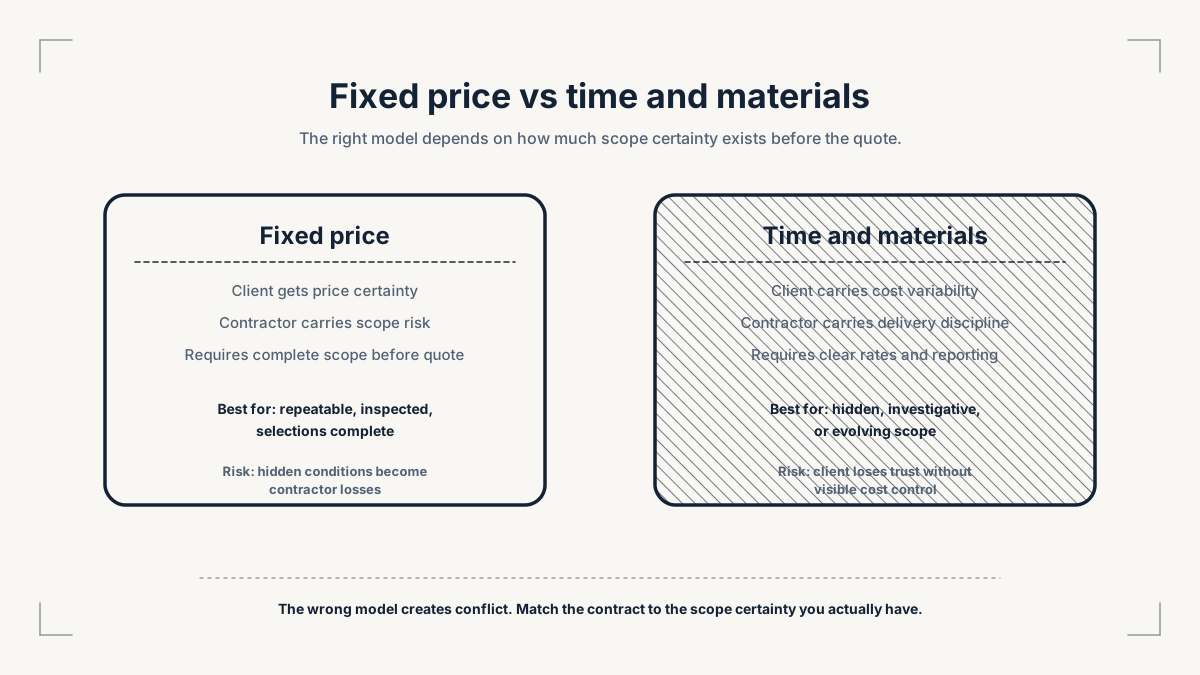
A fixed price contract gives the client a defined scope for a defined price. The contractor carries the financial risk if the work costs more than expected, unless the contract excludes that risk or a change order applies.
A time and materials contract charges the client for actual labor, materials, subcontractors, and agreed markup or margin. The client carries more cost variability, while the contractor carries less risk from unknown scope.
The real question is not which model sounds better. The real question is who is being asked to carry uncertainty, and whether that is fair based on what is known about the job.
Forja's view is straightforward: the pricing model should follow the risk. A repeatable installation, an old-home remodel, a roofing correction, and a premium fit-out are not the same pricing problem.
That decision belongs before the quote is issued. If the work is not yet knowable, a fixed price can create false confidence. If the work is simple and repeatable, time and materials can make the client feel exposed. A serious contractor has to match the contract model to the amount of scope certainty they actually have. For the pricing system that sits behind that decision, see the contractor pricing strategy guide.
What is the real difference between fixed price and time and materials?
Fixed price and time and materials are often described as pricing methods. That is true, but incomplete.
They are also risk-allocation methods.
In a fixed price model, the client buys certainty. They know the price before work starts. That certainty has value, but it is only responsible when the contractor can understand the work well enough to price it.
In a time and materials model, the client buys flexibility. The work can adapt as conditions become clear, but the client needs reporting, trust, and cost visibility.
NetSuite's fixed-price and time-and-materials explainer frames the difference around project certainty, cost risk, and billing structure. Procore's guide to time and materials versus fixed fee also makes the construction distinction clear: fixed fee gives price certainty, while time and materials tracks actual cost and time.
For home improvement contractors, the distinction becomes practical:
Client certainty
High
Lower unless capped or reported tightly
Contractor risk
Higher
Lower
Best fit
Clear scope and visible conditions
Unknown, investigative, or evolving scope
Main danger
Contractor absorbs hidden work
Client fears open-ended cost
Trust requirement
Trust before contract
Trust during delivery
Margin protection
Depends on estimating accuracy
Depends on time tracking and communication
The wrong model creates conflict. Fixed price on unknown work can quietly transfer all uncertainty to the contractor. Time and materials on simple defined work can make the client feel exposed.
The right model is the one that matches the known risk.
When is fixed price the right model?
Fixed price is the right model when the contractor can define the job with enough confidence to stand behind the number.
That usually means:
- the site has been inspected,
- measurements are complete,
- access is understood,
- selections are made,
- the scope is written,
- exclusions are clear,
- the contractor has production history,
- material prices are valid,
- and change-order rules are agreed before work begins.
Fixed price works well for repeatable work: a known flooring installation, a defined painting scope, a standard replacement, a small repair package, or a repeatable service where the contractor has actual job-cost data.
It can also work for larger work if the investigation has been paid for and completed. A fixed price after a proper site review, design stage, technical scope, and supplier check is not the same as a blind free quote.
The test is simple:
“Can the contractor explain exactly what is included, what is excluded, what assumptions were used, and what changes the price?”
Forja Insights
If the answer is yes, fixed price can create trust.
If the answer is no, fixed price may only create false certainty.
When does fixed price become a margin trap?
Free Tool
Estimate Margin Audit
Audit the margin in your next estimate before the quote leaves the business — where owner pay, overhead, scope, risk, pricing model, and change-order control are quietly eroding profit.
Audit my next estimate5 min · Free · No credit card
Fixed price becomes dangerous when the contractor gives a final number before the job is knowable.
The most common warning signs are:
- old structures that have not been opened,
- hidden water damage,
- roof conditions that cannot be inspected fully,
- incomplete client selections,
- unclear access,
- vague drawings,
- missing measurements,
- long lead times,
- volatile material pricing,
- client-supplied items,
- and a client who expects to keep deciding as work progresses.
A recent founder-observed case shows the problem clearly. A contractor quoted a complete interior design and fit-out project without visiting the site, taking measurements, or understanding the full scope. Roofing calculations were wrong, the roofing work had to be repeated, interior work was delayed, and a planned 3 to 6 month move-in stretched to about a year. By the end, the client had lost trust.
That was not only a delivery failure. It was a pricing-model failure.
The contractor used a price before earning the right to know the price.
This is where contractors often confuse confidence with professionalism. A fast fixed price may feel decisive. But if the price ignores hidden conditions, client decisions, and material risk, it is not professional. It is exposure.
Forja's Scope-Risk Contract Ladder is a useful rule:
Repeatable and inspected
Fixed price
Repeatable but selections not complete
Fixed price with allowances
Known work with a few uncertain elements
Hybrid: fixed scope plus allowances and exclusions
Hidden or investigative work
Time and materials
Large custom work with evolving decisions
Cost-plus or staged paid design before fixed delivery quote
Client budget below the walk-away floor
Re-scope or decline
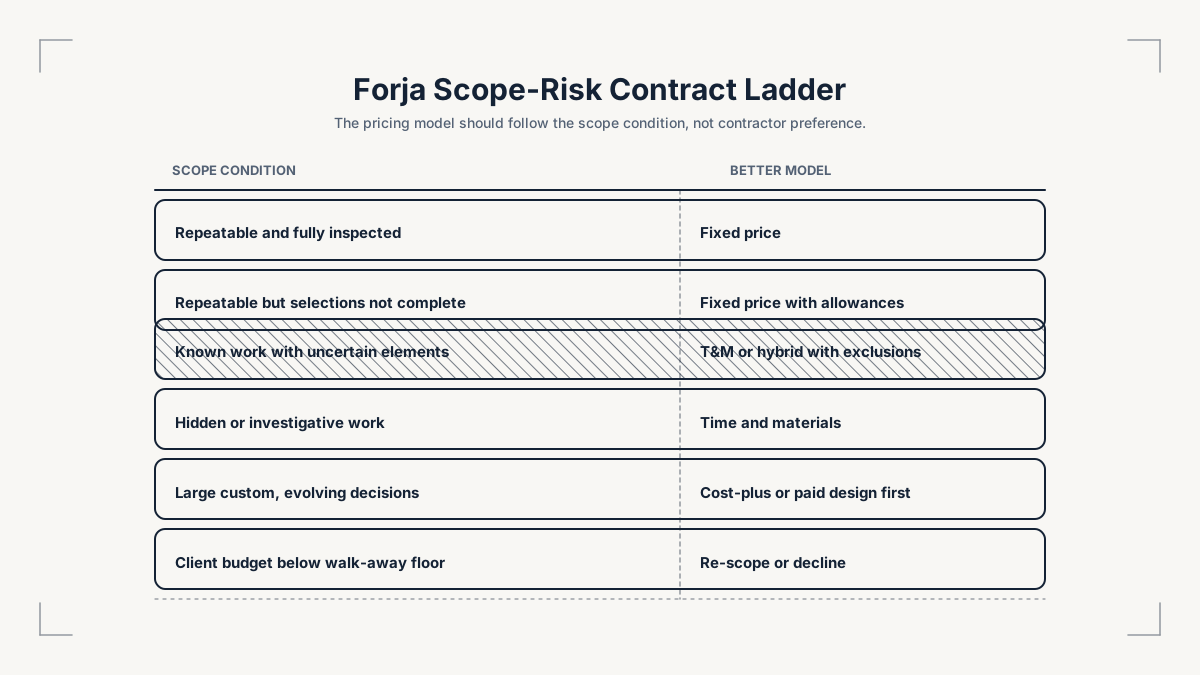
The ladder is not about avoiding fixed price. It is about refusing to use fixed price where the job itself is still moving.
When should contractors use time and materials or cost-plus?
Time and materials is appropriate when the contractor cannot responsibly know the final cost before work begins.
That includes:
- opening walls,
- tracing leaks,
- correcting previous work,
- investigating damp,
- repairing roof failures,
- working around unknown structure,
- or helping a client make decisions while the project evolves.
Cost-plus is similar in spirit, but usually more formal. The client pays actual cost plus an agreed contractor fee or percentage. It can work for larger custom projects where transparency is high and the client accepts that the final cost will move with decisions and conditions.
Neither model removes the need for discipline.
T&M still needs:
- clear hourly rates,
- material markup rules,
- daily or weekly time records,
- client updates,
- decision logs,
- approval thresholds,
- and a not-to-exceed discussion where appropriate.
Cost-plus still needs:
- a defined fee,
- cost-reporting cadence,
- rules for subcontractors,
- rules for owner labor,
- exclusions,
- and written approval for scope changes.
The contractor cannot use T&M as a substitute for communication. If the client only discovers the cost at the end, the model may be technically fair and still commercially damaging.
Rhumbix's contract comparison emphasizes the operational role of tracking and reporting in these models. Forja's addition is the client-trust layer: T&M needs visible control, not just accurate billing.
How should allowances work?
An allowance is a temporary budget line for an item that has not been fully selected, priced, or specified.
Allowances can protect both parties. They let work move forward when the client has not chosen the exact tile, fixture, hardware, appliance, cabinet finish, roofing material, or specialist item.
But a weak allowance creates conflict.
Bad allowances are vague:
"Bathroom fixtures allowance"
Does not say what quality level was assumed
"Kitchen allowance"
Too broad to manage
"Tile not yet selected"
No price, quantity, supplier, or decision deadline
"Client to choose later"
No trigger for price movement
Good allowances are specific:
"Wall tile allowance: $45 per square metre, supply only, client selection due by June 15"
Defines budget, unit, scope, and deadline
"Lighting allowance: 8 fittings at $120 each, installation priced separately"
Separates supply from labor
"Cabinet hardware allowance: $600 supply allowance, changes above allowance billed by written approval"
Makes overrun visible before purchase
The Forja Allowance Quality Test has five questions:
- What exact item does the allowance cover?
- What quantity or unit price is assumed?
- What quality level or supplier range is assumed?
- Who must approve the selection?
- What happens if the client chooses above or below the allowance?
If those five questions are not answered, the allowance is not protecting the job. It is delaying the argument.
UK contractors working under JCT Intermediate or Minor Works forms will recognise the same tension under a different name. JCT contracts distinguish between defined provisional sums (measurable, scope understood) and undefined provisional sums (investigative, scope not yet known). Undefined provisional sums give the contractor stronger grounds to recover additional time-related costs when the work proves more extensive than anticipated. The principle maps directly: name the item, state the assumption, and agree the adjustment trigger before work begins. The terminology changes by market; the discipline does not.
What should trigger a change order?
A change order is a written agreement that changes the original scope, price, timeline, or assumptions.
It should happen before the additional work is performed.
Change orders are often treated like paperwork. That is the wrong frame. A change order protects the original promise. It prevents the contractor and client from pretending the job is still the same after the facts have changed.
Use a change order when:
Client adds scope
Adds built-ins, extra room, upgraded finish
Price and timeline
Client changes selection
More expensive tile, fixtures, hardware
Allowance adjustment
Hidden condition appears
Rot, damp, damaged substrate, unsafe wiring
Scope, price, timeline
Access changes
Client blocks agreed work area or delays keys
Schedule and cost
Material price moves
Supplier price changes after validity period
Material cost
Regulatory or safety issue appears
Permit, inspection, safety correction
Scope and cost
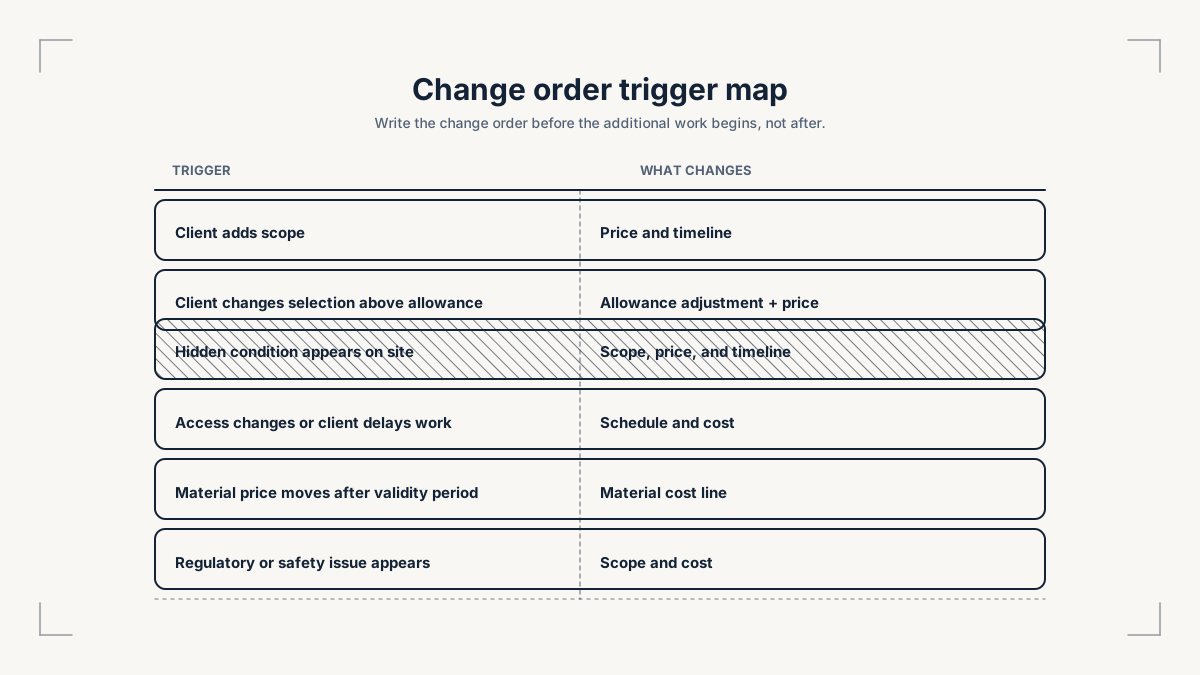
The rule is simple:
“If the job is no longer the job that was priced, the paperwork should say so before the work continues.”
Forja Insights
This is also where client communication matters. Contractors often wait until the end to explain changes because they want to avoid an uncomfortable conversation. That delay makes the conversation worse. Early change-order discipline is not adversarial. It is professional.
How do paid estimating and paid design fit in?
Complex work often needs a paid investigation stage before a responsible delivery quote exists.
For small repeatable work, a free estimate may be a reasonable sales cost. For design-led fit-out, remodeling, roofing correction, structural uncertainty, or multi-trade work, the estimate itself may require real professional labor:
- site visit,
- measurement,
- photography,
- drawings,
- supplier checks,
- material selection,
- technical review,
- sequencing,
- access planning,
- and risk assessment.
That work has value.
The commitment ladder should be:
Site review
Measurement, constraints, visible conditions
Pricing assumptions
Design or technical scope
Layout, selections, technical decisions
Scope brief
Delivery quote
Final scope, allowances, contract terms
Executable price
This protects the client as well as the contractor. The client gets a more reliable decision. The contractor avoids pretending that a complex job can be priced from a quick visit or a few photos.
Paid estimating also filters clients. A client who expects a contractor to absorb serious investigation for free may not understand the complexity of the work. That is a signal before the job starts. For the full cost framework that makes paid estimating viable, see contractor markup, margin, and overhead.
How should contractors explain the pricing model to a client?
The model choice should be explained as risk control, not contractor preference.
Do not say:
“"I prefer time and materials."”
Forja Insights
Say:
“"I can give you a fixed price for the defined parts. For the hidden parts, I would use time and materials with weekly reporting, because neither of us can see those conditions until the work is opened."”
Forja Insights
Do not say:
“"That is just an allowance."”
Forja Insights
Say:
“"This allowance is for the item you have not selected yet. If you choose above it, the difference is approved before we order. If you choose below it, the price comes down."”
Forja Insights
Do not say:
“"That is a change order."”
Forja Insights
Say:
“"The original quote did not include this new scope. I will write the change clearly so you can approve the cost and timing before we proceed."”
Forja Insights
This is how contractors protect trust. The client may not know contract terminology. They do understand fairness, clarity, and no surprises.
What does this reveal about Forja contestants, sponsors, and judges?
Forja is built around Design → Build → Release. A contestant cannot prove execution quality only by saying they found a paying customer.
They also need to show they understand delivery risk.
Pricing model choice reveals that judgment.
A founder who uses fixed price for everything may be hiding uncertainty. A founder who uses T&M for everything may be avoiding the discipline of defining scope. A stronger operator knows when to use each model, when to stage commitment, when to charge for design, when to use allowances, and when a change order is needed.
That matters to sponsors and partners because it shows maturity. Software partners, finance partners, material suppliers, insurers, and education partners all want operators who understand the business problem before they buy the product.
The goal is not to make contracts complicated.
The goal is to make the risk visible before it damages margin, quality, or trust.
FAQ
Is fixed price better than time and materials?
No. Fixed price is better when scope is clear and risk is low. Time and materials is better when the work is exploratory or uncertain. The problem is not either model. The problem is using the wrong model for the risk.
When should a contractor avoid fixed price?
Avoid fixed price when the site has hidden conditions, client selections are incomplete, measurements are missing, access is unclear, material prices are volatile, or the client expects to keep changing decisions during the project.
What is an allowance in a contractor quote?
An allowance is a temporary budget line for an item that has not been fully selected or priced. It should specify the item, amount, quantity or unit, quality assumption, decision owner, and what happens if the final choice is above or below the allowance.
What should trigger a change order?
A change order should be triggered by added scope, changed selections, hidden conditions, access delays, material price movement, regulatory issues, safety issues, or any change that affects cost, time, or the original assumptions.
Is time and materials fair to clients?
It can be fair when the contractor provides clear rates, cost reporting, approval thresholds, and regular updates. T&M becomes risky for client trust when the contractor fails to communicate cost movement during the job.
Should estimating or design be paid?
For complex work, yes. Site review, measurement, layout, selections, supplier checks, technical scope, and delivery sequencing can be real professional work. Paying for that work can produce a more reliable quote and a better client decision.
Use this when the quote also needs overhead recovery, owner pay, risk reserve, and margin discipline.
Use this when the question is whether the price covers overhead, owner pay, risk, and profit.
THE FORGE
Use the Estimate Margin Audit
Audit the margin in your next estimate before the quote leaves. Score the six controls, see the weakness costing the most margin, and get one partner-tool recommendation matched to the problem.
Use the Estimate Margin Audit