

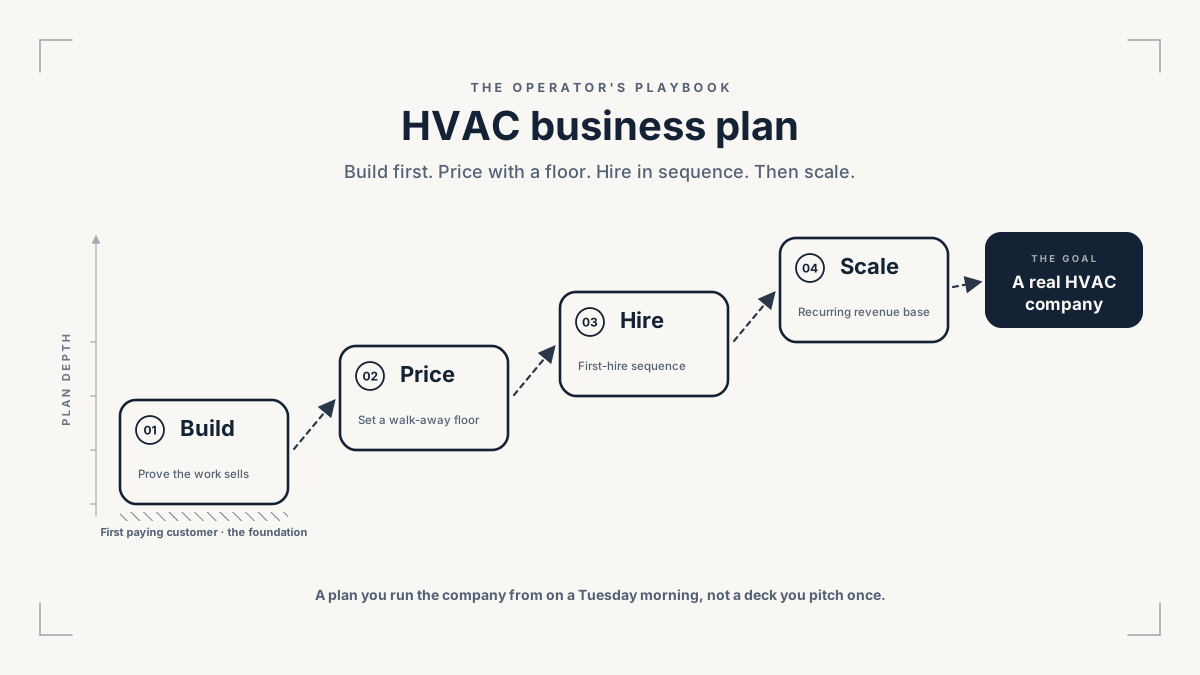
Most HVAC business plans are written for a bank loan officer or a template website, not for the operator who has to live inside the plan when a tech calls in sick and a customer wants a refund on the same Tuesday morning.
A strong HVAC business plan that survives past month six shares three traits: it prices the business, not just the job; it names who the first hire actually is and what that hire is for; and it tells the founder exactly when the plan has done its job and needs to retire. Those traits separate a working HVAC business plan from one that sits in a drawer.
This guide covers how to build that kind of HVAC business plan, what belongs in each section at each operating stage, and the trigger points that tell you whether to scale, stabilise, or extend into another trade.
KEY TAKEAWAYS
- An HVAC business plan is a decision-and-discipline document, not a fundraising deck.
- Operating stage decides plan depth. A one-truck owner-operator writes a different plan than a twelve-truck operation chasing $3M.
- Fewer than 2% of contractors charge for the planning that goes into a pre-estimate. The plan that fixes this single fact changes the financial model more than any marketing spend.
- Hire your first dispatcher before your second technician. The order matters because it sets the operating ceiling.
- The plan is finished the day it stops telling you what to do next. That trigger is the entry point to a real operating manual.
DEFINITION
An HVAC business plan is the document an operator uses to decide pricing, hiring, capacity, and operating-stage transitions before the market decides for them. It is a decision-and-discipline document for the operator, not a fundraising deck for a banker.
What does this article promise?
An HVAC business plan is the document an operator uses to decide pricing, hiring, capacity, and operating-stage transitions before the market decides for them. That is the whole job.
It is not a fundraising deck. It is not a template fill-in exercise with an "Executive Summary" and a "Company Description" copied off a website. It is not a vision statement, a mission paragraph, or a five-year revenue projection built on a hopeful spreadsheet.
The reason this distinction matters: a fundraising deck answers a banker's question, which is usually a version of "will I get paid back". A real operator plan answers the founder's question, which is "what do I do on Tuesday morning when the dispatcher quits and the lead tech needs a raise and the new install is two days behind". A plan written for the banker is silent on Tuesday morning. A plan written for the operator has an answer on the page.
Most contractors who hire someone to write their business plan get the banker version. The plan goes into a drawer the day funding is approved (or denied) and stays there. The contractor goes back to running the company by instinct. Six to eighteen months later, instinct hits a ceiling. The plan in the drawer cannot help, because it was never built to.
This guide builds the operator version. Every section answers a question the founder will actually face in the next ninety days, the next twelve months, or the next operating stage.
What is an HVAC business plan (and what is it not)?
If you have never worked a real HVAC job, never closed a paying customer, and never spent a full Saturday on a service call, do not write this plan yet. Whatever you write will be fiction wearing a business-plan costume.
The reason is simple. Every meaningful decision in a business plan (price floor, hiring sequence, capacity ceiling, recurring-revenue strategy, software readiness) depends on knowing what one real job feels like from quote to invoice. Without that, you will guess wrong on the assumptions, lock those guesses into a document, and spend the first eighteen months unlearning them at full operating cost.
If you are in this position, do one of two things this week instead. Shadow an active HVAC operator for three days, including a Saturday on-call rotation. Or close one paid job, even a small one, on your own. Either gives you the field reality you need before you write a single section of this plan.
When you come back, write the plan against what you saw. It will be a different plan than the one you would have written without that week. It will also be the one that survives.
This article will not chase the "how to start an HVAC business with no experience" reader. That reader needs a different resource. We are writing for the operator who has at least one paying job behind them and at least one decision in front of them.
Who is this plan not for?
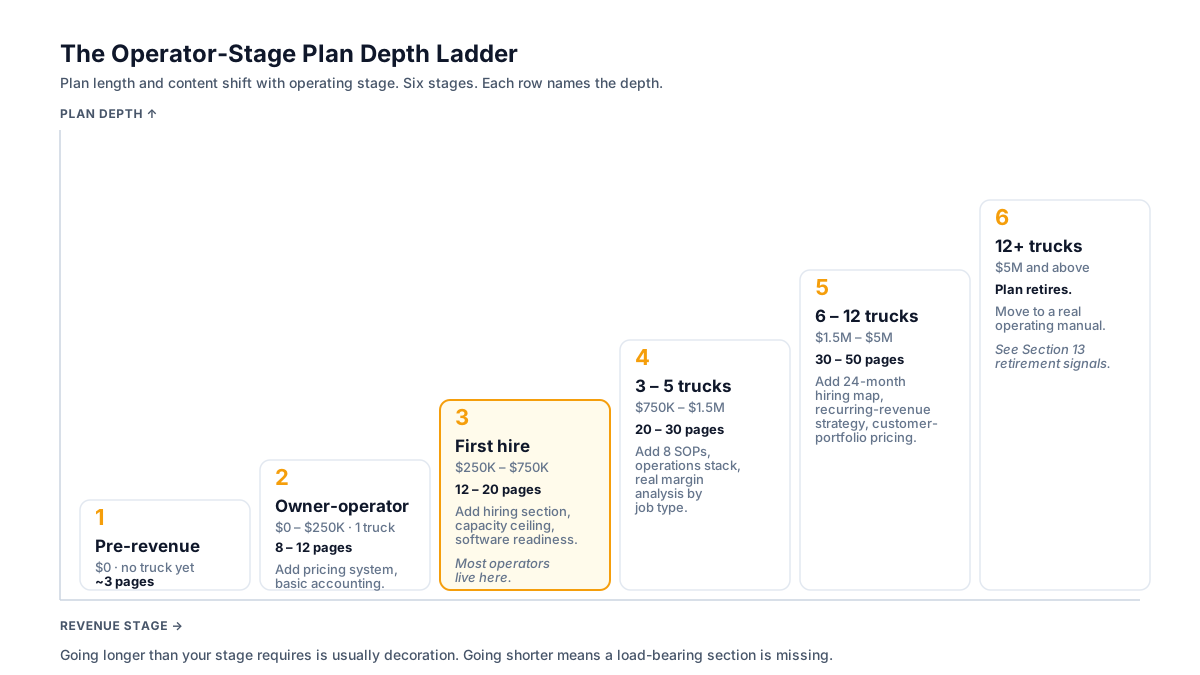
The single biggest mistake in HVAC business planning is writing the same plan at every stage. A one-truck owner-operator does not need a hiring section. A twelve-truck operation does not need a "do I incorporate" section. The plan changes shape because the operator's decisions change.
Use the Forja Operator-Stage Plan Depth Ladder. Six stages. Each stage names what the plan must include and what it can leave out.
**Stage 1, pre-revenue.** You have a name, a logo, and a plan to start. The only sections that matter are licensing, insurance, first-truck cost, starting price book, and the one trade segment you will focus on for the first ninety days. Skip the marketing chapter. Skip the org chart. Skip the five-year projection. Write three pages.
**Stage 2, owner-operator with one truck, $0 to $250K.** Add a pricing system, a daily-route sketch, a basic accounting setup (separate business account, monthly reconciliation), and a one-page recurring-revenue concept (will you offer a maintenance agreement, yes or no, what does it cost). Write eight to twelve pages.
**Stage 3, first hire, $250K to $750K.** Add a hiring section that names the role, the salary band, and what changes about your time. Add a capacity ceiling calculation: how many jobs per week can this two-person operation handle. Add a software-readiness check (spreadsheet still works, or do you need a simple field service management tool). Twelve to twenty pages.
The market backdrop matters here. The Harvard Joint Center for Housing Studies Leading Indicator of Remodeling Activity, Q1 2026 release, projects homeowner improvement and maintenance spending to total $522 billion in 2026, with growth easing from 2.9 percent in Q1 to 1.6 percent by Q4. Demand is sustained but slowing. That tells you the plan you write this year cannot rely on a rising tide to cover weak pricing or weak hiring; the operating discipline has to carry the operation.
**Stage 4, three to five trucks, $750K to $1.5M.** Add SOPs for the eight recurring tasks (dispatch, install kickoff, service call protocol, change-order rule, payment terms, warranty response, customer complaint, after-hours call). Add an operations-stack assessment. Add a real margin analysis by job type. Twenty to thirty pages.
**Stage 5, six to twelve trucks, $1.5M to $5M.** Add a full hiring map for the next twenty-four months. Add a recurring-revenue strategy with attach-rate targets. Add a customer-portfolio pricing layer (commercial accounts at one price floor, residential at another, emergency call-outs at a third). Thirty to fifty pages.
**Stage 6, twelve-plus trucks, $5M and above.** At this stage the plan starts retiring itself. You need an operating manual, not a plan. We come back to this in Section 13.
Knowing your stage tells you what to write and, just as importantly, what to skip. A Stage 2 operator writing a Stage 5 plan is wasting time. A Stage 5 operator running on a Stage 2 plan is leaking margin.
For the operating-stage software trigger, the right software tier is decided by your stage on this ladder, not by what your competitor uses.
How Does Operating Stage Decide HVAC Business Plan Depth?
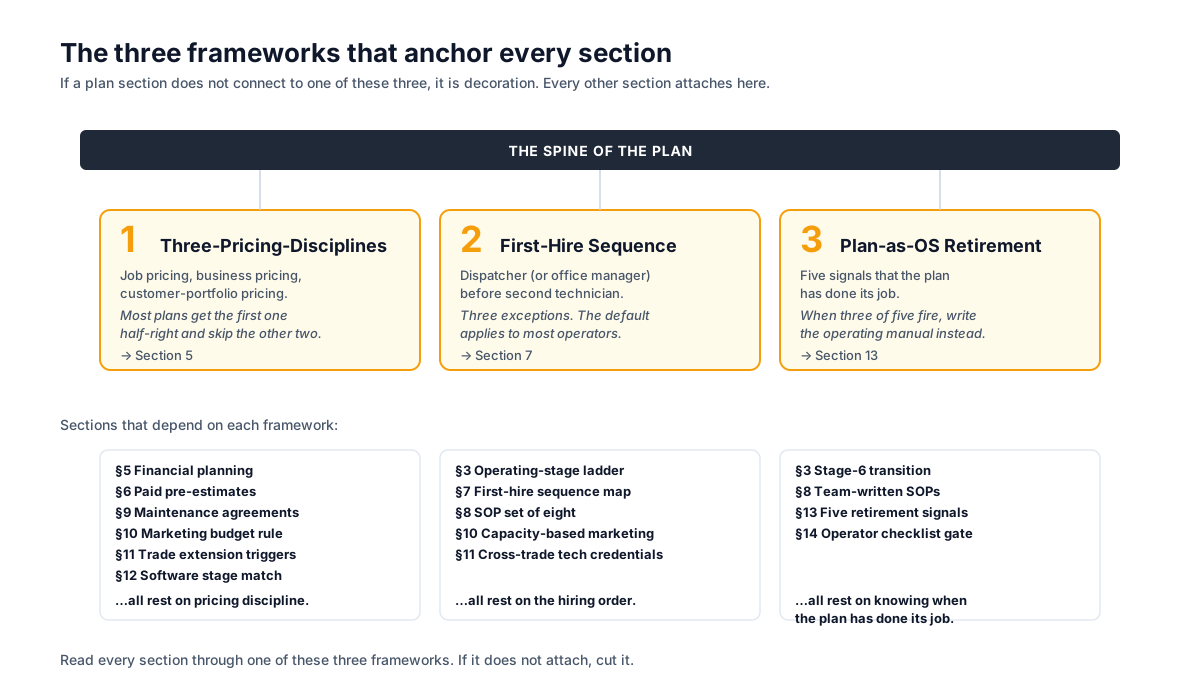
Every section of an HVAC business plan answers to one of three frameworks. If a section in your plan does not connect to one of these, it is decoration.
**Framework 1: the Three-Pricing-Disciplines.** Job pricing, business pricing, and customer-portfolio pricing. Job pricing is the price you put on a single quote. Business pricing is the price floor below which no job is worth doing, because it does not recover the cost of running the business. Customer-portfolio pricing is the price strategy across your full book, including which customers you keep and which you fire. Most plans get the first one half-right and ignore the other two. The full framework is in Section 5.
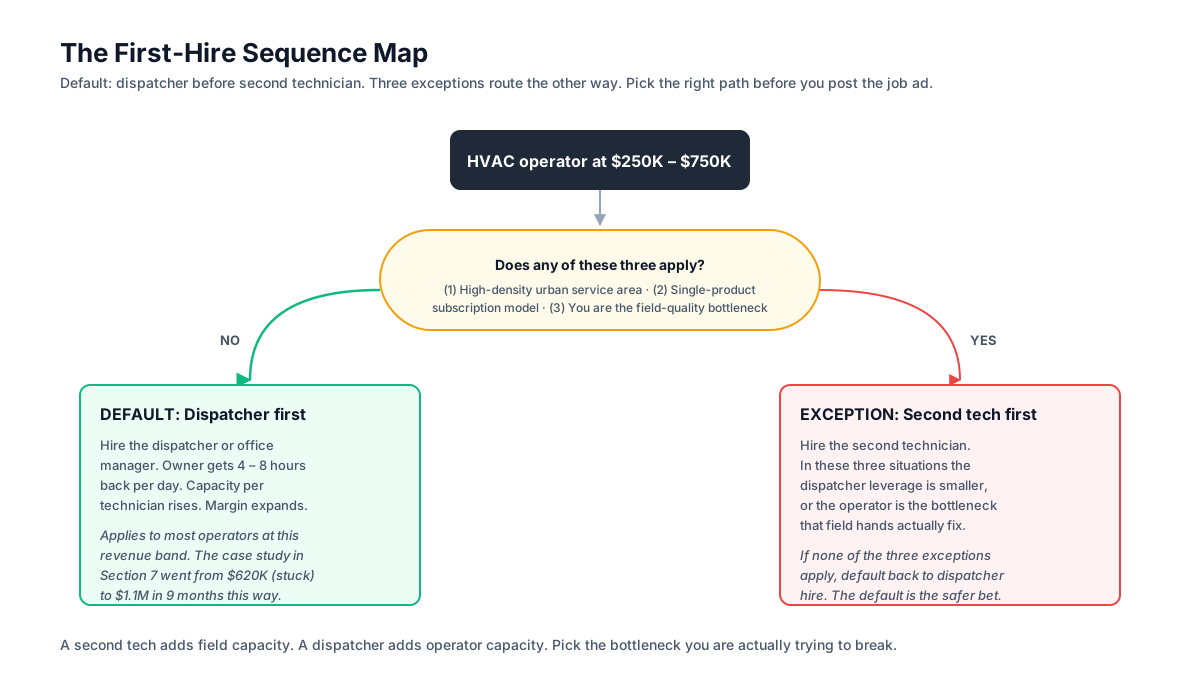
**Framework 2: the First-Hire Sequence.** Every HVAC operator at the $250K to $750K mark has to decide who hires first: a second technician or a dispatcher (or office manager). The default is wrong for most operators. The framework gives you the rule and names the three exceptions. The full framework is in Section 7.
**Framework 3: the Plan-as-Operating-System Retirement Signals.** Five concrete signs that the plan has done its job and needs to retire into an operating manual. The framework is in Section 13.
These three frameworks are the spine of the plan. The sections that follow (financial, hiring, SOPs, recurring revenue, marketing, software, trade extension) each apply at least one of them.
What three frameworks anchor every HVAC business plan financial section?
The financial section of an HVAC business plan must price the business, not just the job. Most fail at this step.
A job-only financial plan reads like this: parts cost plus labour cost plus a markup equals the price. If the customer pays, the operator declares the job profitable. This works until overhead, owner pay, risk, and recurring tools-and-software cost show up at the end of the month and eat the apparent profit.
A business-pricing financial plan recovers five inputs on every job, not three. Direct cost. Burdened labour rate. Overhead recovery. Owner pay. Risk reserve. Profit lives above all five, not inside any of them.
Direct cost is straightforward: parts, materials, refrigerant, permits, subcontractor invoices. The number on the supplier receipt.
Burdened labour rate is where most operators lose money. It is not the technician's hourly wage. It is the wage plus payroll taxes, workers' compensation, vehicle cost allocated to that technician, insurance, paid time off, training time, and the share of supervision the lead tech provides. According to the BLS Occupational Employment and Wage Statistics May 2024 release, the median annual wage for HVAC mechanics and installers is $59,810 (median hourly $28.75), with the bottom 10 percent below $39,130 and the top 10 percent above $91,020. On those base wages, the fully burdened rate typically runs 1.5 to 1.9 times the base hourly figure. If you bill at the base wage, you are losing money on every billable hour.
Overhead recovery is the share of business operating cost (office rent or share of home, software stack, accounting, marketing, vehicle finance, fuel, tools, insurance, legal, training) that every job must contribute. Add up your annual overhead. Divide by your billable job hours. Add that number to every quote.
Owner pay is your salary as a technician, dispatcher, salesperson, or project manager, depending on which roles you are still running. It is not the same thing as profit. A plan that pays the owner only out of leftover profit is hiding weak unit economics. Pay yourself a number, then see if the business is profitable above that number.
Risk reserve is the line item most contractors skip. Field work is unpredictable. Weather, hidden conditions, customer indecision, accidents, warranty callbacks, and supply delays all cost money. A 5 to 10 percent reserve on every quote is the minimum. On a complex remodel or a multi-trade project, push it higher.
For the deeper pricing system that turns these five inputs into a defensible price, build a real price floor before you sell another job. The pillar covers the full Forja Pricing Pyramid and the walk-away floor formula.
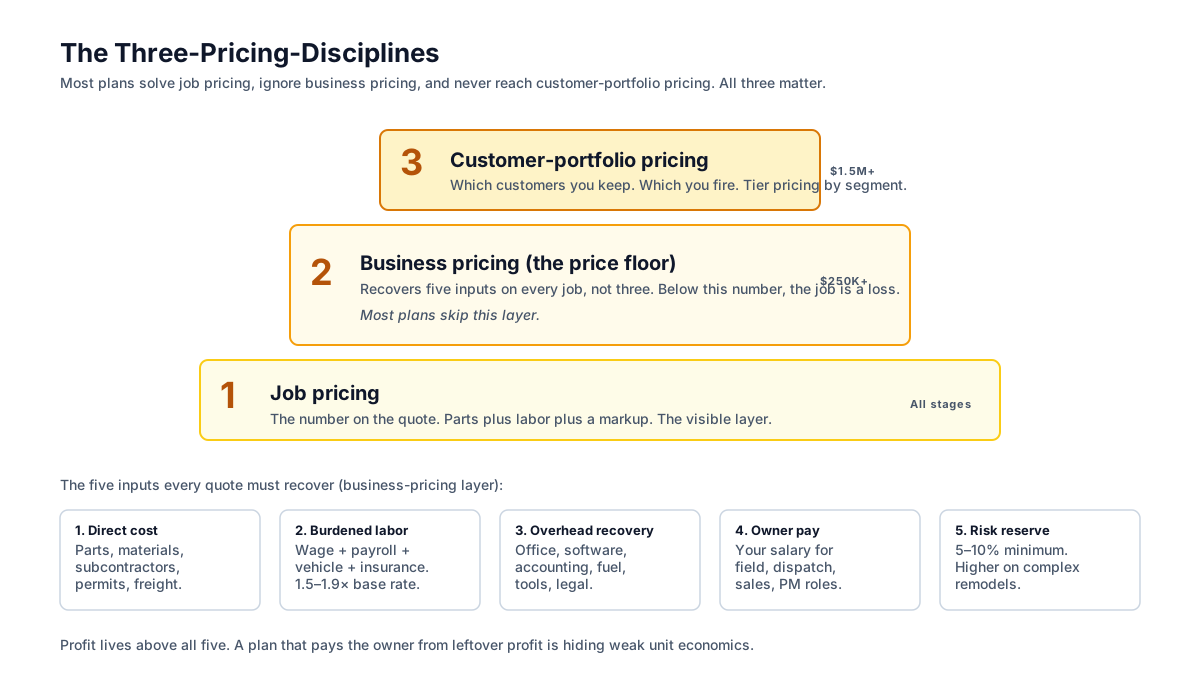
Once your financial section recovers these five inputs, run a worked example. A three-truck residential HVAC operation in the US Midwest, sixty billable hours per week per truck at a blended residential rate, overhead of $180,000 per year, owner pay of $90,000, a 7 percent risk reserve, and a 12 percent net profit target. The plan answers what every quote must clear before the operator says yes to the job. Write that number down. That is your business price floor.
Benchmark the target against the NAHB Cost of Doing Business Study, 2026 Edition, which reports residential remodelers reached a 29.9 percent average gross profit margin and a 6.3 percent net profit margin on 2024 data, the highest net margin in nearly 30 years. The HVAC service-trade economics differ from remodeling (different cost mix, different labour ratios), but the discipline question is the same: does your plan produce a price that recovers all five inputs and still hits a net margin in that range, or are you running below benchmark and calling it "tight market".
How do you build a financial plan that survives the first job?
Fewer than 2% of contractors charge for the planning that goes into a pre-estimate. The other 98% give that planning away. Closing this single gap will move the financial model more than any marketing campaign you run in year one.
The reason is structural. A complex HVAC pre-estimate (system replacement, ductwork survey, load calculation, equipment sizing, code review, install plan) takes two to six hours of senior time. The contractor who gives that away absorbs $200 to $600 of unrecoverable senior time per opportunity, and converts maybe one in three. Across twenty opportunities a month, that is $4,000 to $12,000 in unbillable expert work, every month, forever.
The contractor who charges $200 to $400 for the paid pre-estimate recovers most of that time. Conversion rates do not collapse; they often improve, because paying customers are pre-qualified by the willingness to pay. The customer who refuses to pay $300 for a serious pre-estimate is almost always the customer who will negotiate the install price down to a loss, dispute the change orders, and write a one-star review if the system needs a follow-up visit.
The plan needs three things to make paid pre-estimates work. First, a three-stage commitment ladder: a free fifteen-minute qualification call, a paid pre-estimate planning visit at $200 to $400, and a final delivery quote. Second, a customer script that handles the "but other contractors come out for free" objection in one sentence ("they do, and they price the planning into the install at a higher rate or a thinner margin; we charge for it up front so the install price is honest"). Third, a written deliverable the customer keeps even if they do not move forward (the load calculation, the equipment recommendation, the install plan).
For the conversation script that wins this without losing the customer, see the script that wins the paid inspection conversation.
This is also where the second cross-cluster link lives. Why a paid pre-estimate is the price-floor conversation in disguise shows the deeper logic: the paid pre-estimate is not a fee, it is the moment you tell the customer what your business price floor is.
Why do fewer than 2% of contractors charge for pre-estimates?
For most HVAC operators between $250K and $750K revenue, the first hire that protects margin is a dispatcher or office manager, not a second technician. The default instinct (hire another set of hands to do more jobs) is the wrong move for the majority. This section says why.
A second technician adds capacity to the field. A dispatcher adds capacity to the operator. The operator who hires a second tech first usually keeps doing the dispatching, the quoting, the customer follow-up, the invoicing, and the supplier calls. The new tech runs jobs the operator has scheduled, but the bottleneck (the operator) does not move. The operation runs at slightly more than one-truck capacity for the cost of two trucks. Margin shrinks.
A dispatcher (or office manager, depending on what the operator calls it) absorbs the schedule, the customer-facing phone, the quoting prep, and the invoicing follow-up. The operator gets four to eight hours back per day. Those hours go into sales calls, lead-tech mentoring, supplier negotiation, and quality control on installs. Revenue capacity per technician goes up. Margin expands.
**Anonymised case anchor.** A Midwest US HVAC operator, two trucks, residential service and light commercial, hired a second technician at around the $600K mark. Stayed stuck near that revenue level for roughly nineteen months. Owner was doing dispatching, quoting, customer follow-up, and quality control on every install. Eventually hired an office manager. Within nine months, the operation grew past $1M with the same field team plus the office hire. The capacity ceiling was the owner's calendar, not the field crew.
That case is not unusual. It is the common shape.
There are three exceptions. Second technician hires first if (1) you operate in a high-density urban service area where every dispatch is a fifteen-minute drive and the dispatcher's leverage is smaller; (2) you run a single-product subscription model (for example, maintenance-only or filter-replacement service) where the operations are routinised and the dispatch decision is mostly automatic; or (3) you are personally the bottleneck on field quality, you have a senior lead tech ready to take over installs, and the second-tech hire is your succession plan rather than your capacity move.
If none of those three apply, hire the dispatcher first.
For the office manager role, written as a job description not a wish list, the spoke article gives the full hiring sequence with the salary bands, the interview questions, and the first-ninety-days plan.
Should you hire a dispatcher or a second technician first?
Continuity is the difference between a business that can be sold and a job that pays the founder. Standard Operating Procedures (SOPs) are the cheapest insurance an HVAC operator buys. They cost a weekend per SOP. They save weeks every time someone leaves, gets sick, or gets promoted.
A real SOP is not a corporate-style binder. It is a one-page document with six fields: Trigger (what starts this work), Owner (who runs it), Inputs (what they need before starting), Steps (numbered, with the order that matters), Edge Cases (what to do when the normal flow breaks), and Escalation (who to call when the edge case breaks).
By the time you are running four trucks, you need eight SOPs. Dispatch (how a call becomes a scheduled job). Install kickoff (what happens between the signed quote and the truck arriving on site). Service call protocol (the technician arrival, diagnosis, customer conversation, and parts call). Change-order rule (what is a change, who approves it, what the customer signs, what gets added to the invoice). Payment terms (deposit, progress payment, final, late). Warranty response (the customer call, the diagnosis visit, the resolution, the documentation). Customer complaint (the first conversation, the recovery action, the follow-up). After-hours call (who picks up, what gets answered tonight, what waits for morning).
**Anonymised case anchor.** A UK plumbing operator (the lesson applies cleanly to HVAC) lost two senior installers in the same month. The operation kept on-time completion above 90 percent because the dispatch SOP and the install kickoff SOP described every recurring service type in numbered steps. The new hires followed the SOPs from day three. Without the SOPs, the operation would have lost a quarter of its booked revenue inside six weeks.
The investment is small. The protection is large.
For the full set of eight templates, see the eight SOPs that hold the operation together.
If you suspect your operation is leaking margin between the SOPs you have and the SOPs you should have, the Revenue Leak Audit is the diagnostic. It surfaces the four most common leak points (dispatch, change orders, payment terms, warranty cycles) and tells you which SOP is missing or stale.
Which 8 SOPs hold the operation together?
Recurring revenue is the asset that makes an HVAC business worth more than the sum of its trucks. Maintenance agreements are the cheapest way to build it.
A one-truck owner-operator can build a maintenance book in eighteen months. A four-truck operation that has not started yet is leaving asset value on the table every quarter it delays. At exit, recurring revenue typically trades at a higher multiple than transactional service revenue, because the buyer is buying a predictable cash stream.
The Recurring-Revenue Maturity Curve gives stage-by-stage attach-rate targets. Stage 2 (owner-operator): 5 to 10 percent of customers on a basic maintenance agreement by month twelve. Stage 3 (first hire): 15 to 25 percent attach rate, with two tiers (a basic and a premium). Stage 4 (three to five trucks): 25 to 35 percent attach rate, with a structured renewal motion. Stage 5 (six to twelve trucks): 35 to 50 percent, with commercial accounts on a separate agreement structure.
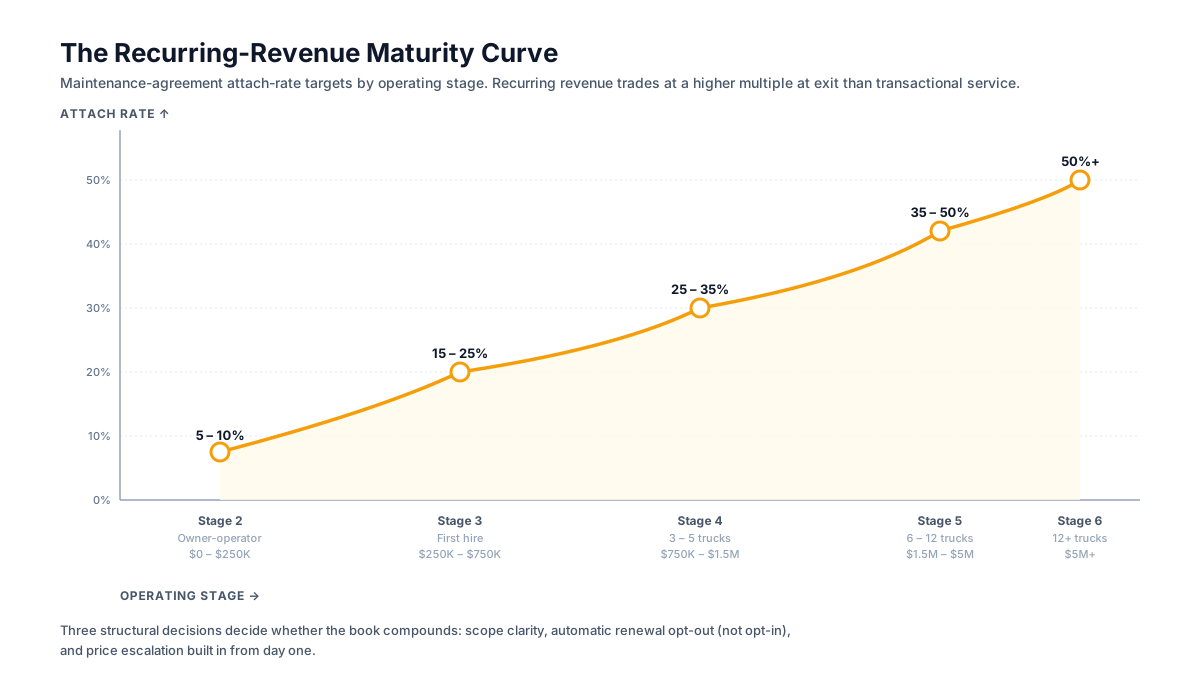
Three structural decisions decide whether the maintenance book compounds.
First, scope clarity. The agreement names exactly what is included (two visits per year, filter change, condenser clean, refrigerant check, twenty-minute electrical inspection) and what is not (parts above $50, refrigerant top-up beyond two pounds, emergency call-outs at full rate). Customers who know exactly what they bought renew at higher rates and complain less.
Second, automatic renewal opt-out, not opt-in. The agreement renews unless the customer cancels by a specific date. Opt-in renewals lose 30 to 60 percent of customers every year for no reason other than friction.
Third, price escalation built in from day one. The agreement says the price increases by a named percentage at each renewal, tied to a public index or a flat 5 to 7 percent. Customers do not push back when the price increase was disclosed at signup. They push back hard when it is sprung on them at year three.
Done well, a maintenance book also gives you a 5 to 15 percent post-project maintenance buffer at a 20 to 25 percent premium, recovering planning time you would otherwise absorb at no charge.
For the agreement structure that does not leak attach rate, see the maintenance agreement that does not leak attach rate.
What maintenance-agreement attach rate should you target by stage?
Marketing for an HVAC operator is not a creative discipline. It is a demand-capture and reputation system. The budget is dictated by capacity, not by what a competitor spends.
The rule: marketing spend should match the revenue capacity you can deliver in the next sixty days, not the revenue you wish you had. A two-truck operation that runs a marketing campaign sized for six trucks ends up with three weeks of booked work it cannot serve, customers waiting, and a stack of one-star reviews from the people it had to push off.
Three demand channels carry the load for most HVAC operators before any fourth channel makes sense.
First, Google Business Profile discipline. Complete every field. Post weekly. Respond to every review in 48 hours. Add real photos (not stock images, real jobs). Most contractors leave 60 percent of this asset's value unused.
Second, neighbourhood referral system. After every job, the customer gets a printed card with a referral incentive (cash credit on their next service, not a discount on someone else's, because discounts attract bargain hunters and credits reward loyalty). Track which customers refer, thank them by name on the second referral.
Third, warranty-period follow-up. Every install gets a thirty-day, ninety-day, and one-year touch (a phone call, not just a text). The thirty-day call catches small complaints before they become online reviews. The ninety-day call is the maintenance-agreement conversation. The one-year call is the referral ask.
These three channels typically deliver 70 to 85 percent of the lead volume a Stage 3 or Stage 4 HVAC operation needs. Lead-platform spend (HomeAdvisor, Angi, lead aggregators) is a fourth channel, not a first one, and most operators overspend on it because it feels active. Activity is not the same as return.
Budget rule: marketing spend at 4 to 8 percent of revenue capacity (not revenue actual), tilted heavier in Stage 2 and Stage 3 (when the brand is unknown), lighter in Stage 4 and beyond (when the maintenance book and referrals carry more weight).
For the marketing budget rule for operators with capacity constraints, the spoke covers the full channel sequence and the budget tilt by stage.
Which marketing channels work for HVAC operators?
Trade extension is a capacity-and-customer decision, not a revenue-target decision. The operators who weaken both businesses are the ones who extend when revenue compresses and they want a second revenue stream to fix it. The operators who succeed extend when the home business runs without them and a real customer pull or technician availability makes the second trade easier than starting over.
Three triggers mean trade extension is the right move.
Trigger one, existing customer demand pull. Your maintenance book and your install customers ask for a related trade service often enough that you are referring three to five jobs a month to a partner. That referral volume is a built-in customer base for the second trade.
Trigger two, technician with cross-trade credentials. You have a senior tech who holds both HVAC and plumbing licences (or HVAC and electrical), and the extension is a single-hire decision rather than a build-from-scratch.
Trigger three, predictable revenue floor on the home trade. Your HVAC operation has at least six months of revenue runway above the business price floor without you working in the field. The home business is the cash engine. The extension is the next compounder.
Two triggers mean trade extension is the wrong move.
Wrong trigger one, revenue compression panic. The HVAC business is shrinking, so the operator chases a second trade to cover the gap. The second trade takes twelve to twenty-four months to reach profitability. The cash gap widens before it closes.
Wrong trigger two, vendor or franchise pressure. A supplier, franchise group, or industry coach pushes the extension as a growth move. The operator extends because the case is compelling, not because the customer pull is real.
If the right triggers are present, the order usually goes HVAC then plumbing (highest customer-pull overlap), then electrical (high-margin add-on for new installs), then roofing (separate customer cycle, longer payback). The trade-extension playbook is in the sibling cluster hubs: the roofing business plan, the plumbing business plan, and the electrical business plan.
Before any extension, run the Revenue Leak Audit on the HVAC stack. If the HVAC home base is leaking margin, the second trade will leak faster.
When should you add plumbing, electrical, or roofing?
Software does not fix a broken plan. It executes a working plan at higher fidelity. The single biggest software mistake in HVAC is installing a platform two operating stages above where the team actually is. The leverage does not appear; the noise does.
Map the operator-stage software thresholds.
**Spreadsheet stage, up to $250K.** A spreadsheet plus a calendar plus a shared inbox is enough. Software adds cost without adding clarity. Skip it.
**Simple FSM stage, $250K to $750K.** A simple field service management tool (the Jobber, Housecall Pro, ServiceM8 category) handles dispatch, quoting, invoicing, and basic customer records. The operator picks the cheapest one that the dispatcher can run without a training week.
**Operations-stack stage, $750K to $3M.** This is where the simple FSM tools start breaking. Quoting workflows multiply. Maintenance agreements need their own logic. Job-costing reporting becomes a financial-decision input, not a curiosity. The operator is ready for a real operations stack. ServiceTitan is the editorial recommendation at this stage for residential and commercial HVAC operations because the platform is designed around dispatch, pricebook, recurring agreements, and reporting at this exact band. *FTC disclosure: ServiceTitan is a Forja Insights affiliate partner. The operator-stage recommendation is editorial; it would stand if the affiliate relationship did not exist.*
**Platform stage, $3M and above.** The operations stack expands into integrations: accounting, marketing automation, customer experience platforms, fleet telemetry. ServiceTitan remains the spine for most residential and commercial HVAC operations at this band, plus a tailored integration set.
The mistake to avoid: installing the operations-stack platform at Stage 3 (one truck plus a dispatcher) because the marketing case is compelling. The dispatcher cannot run it without three weeks of training time the operation does not have, and the operator ends up paying for software the team uses at 15 percent of capacity.
For the deeper operating-stage software trigger (the same anchor that surfaced in Section 3), the spoke covers the exact decision criteria.
When does your operations stack need real field service software?
The plan is finished the day it stops telling you what to do next. That is not a failure. It is the entry point to an operating manual.
Most operators never notice this transition. They keep updating the same plan, adding sections, refreshing numbers, and wondering why the document feels heavier and less useful every quarter. The plan was built to answer the early questions. The early questions are settled. The plan does not have answers to the new ones because those answers live in operating documents, not in a plan.
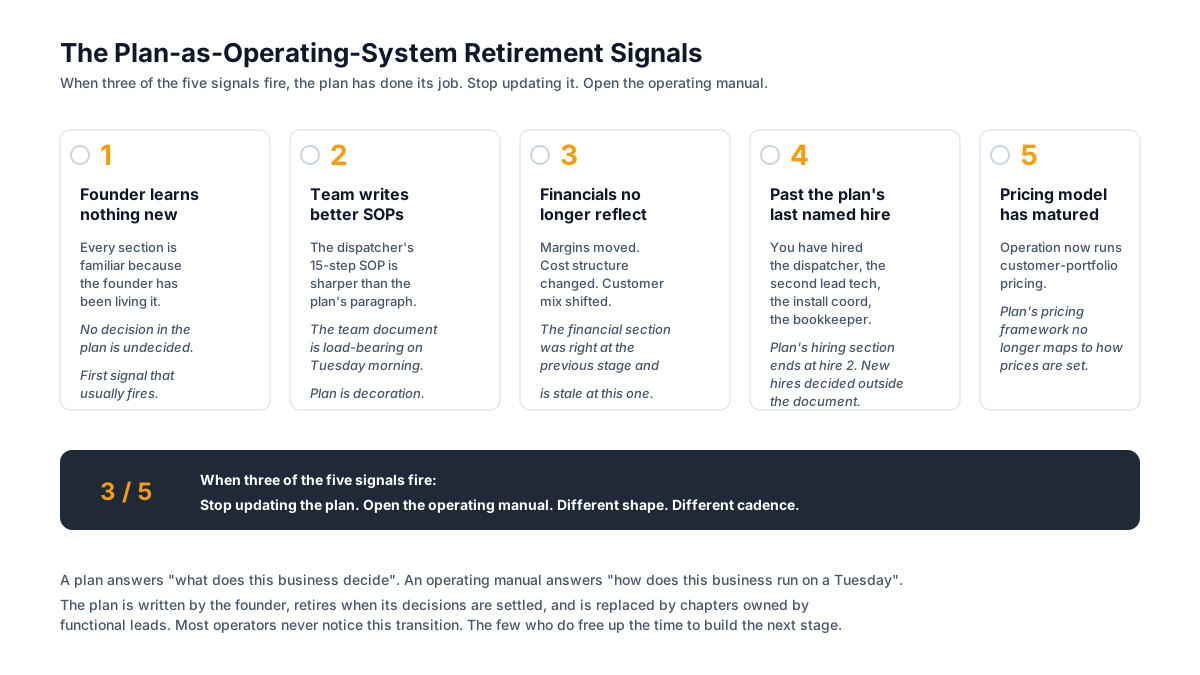
Five signals say the plan has retired itself. When three of the five fire, write the operating manual.
**Signal 1: the founder reads the plan and learns nothing new.** Every section is familiar because the founder has been living it. There is no decision in the plan that is not already decided.
**Signal 2: the team writes better SOPs than the plan section.** The plan has a paragraph about dispatch. The dispatcher has a fifteen-step working document. The team's document is sharper, more current, and load-bearing on Tuesday morning. The plan's paragraph is decorative.
**Signal 3: the financial section no longer reflects the unit economics.** Margins have moved. Cost structure has changed. Customer mix has shifted. The financial section was right at the previous stage and is stale at the current one.
**Signal 4: the hiring sequence has moved past the plan's last named hire.** You have hired the dispatcher, the second lead tech, the install coordinator, and the bookkeeper. The plan's hiring section ends at hire number two. Every new hire decision is made outside the plan.
**Signal 5: the pricing model has matured past the plan's pricing framework.** The plan describes job pricing and a price floor. The operation now runs customer-portfolio pricing, with commercial and residential tracks, a service-agreement tier, and a separate emergency call structure. The plan's framework no longer maps to how prices are actually set.
When three of these fire, the plan has done its job. Stop updating it. Open a new document called the operating manual. The operating manual is a different shape (chapters by function, not sections by topic) and a different cadence (updated by the team that owns each chapter, not by the founder once a year). Forja's framework for that transition is in the operating-manual content (a separate publication track from this plan playbook).
This is the section where the article earns its place in the cluster: most published HVAC business plan content does not name the retirement point. The reader needs it more than the reader needs a thirteenth template.
When have you outgrown the plan and need an operating manual?
Before you open the document, run this twelve-point checklist. If you cannot answer five or more of these in one sentence each, you are not ready to write the plan. Go back to Section 2 or Section 3 first.
- What operating stage am I in right now (Section 3)?
- What is my business price floor for the most common job I run (Section 5)?
- Do I charge for pre-estimate planning, yes or no, and what is the rule (Section 6)?
- Who is my next hire, and what specifically frees up when they start (Section 7)?
- Which two SOPs would protect my operation most if my best person left tomorrow (Section 8)?
- What attach rate am I targeting on maintenance agreements in the next twelve months (Section 9)?
- Which three marketing channels carry my lead volume right now (Section 10)?
- Am I a candidate for trade extension in the next twenty-four months, yes or no, on which trigger (Section 11)?
- What operating-stage software tier matches my actual team capability today (Section 12)?
- What is the one decision I am avoiding that this plan needs to force (overall)?
- Which three retirement signals (Section 13) are already firing, and what does that change?
- Who reads the plan with me every quarter, and what is the one question we ask that quarter?
Save the answers. They become the spine of the plan. The plan writes itself around them.
Download the HVAC Business Plan Operator Checklist (PDF) for the printable version.
What 12-point checklist gates your first plan?
**How long should an HVAC business plan be?** The right length is set by your operating stage. Stage 1 (pre-revenue) is three pages. Stage 4 (three to five trucks) is twenty to thirty pages. Going longer than your stage requires usually means the plan is decorative. Going shorter means a load-bearing section is missing.
**Do I need an HVAC business plan to get a loan?** A lender wants a fundraising-style plan with financial projections, market analysis, and a clear repayment story. That is a different document than the operator plan in this article. If you need both, write the operator plan first (it forces real decisions), then summarise the financial sections for the lender version.
**What is the most common mistake in an HVAC business plan?** Treating pricing as a one-line markup rule instead of a business pricing system that recovers direct cost, burdened labour, overhead, owner pay, risk reserve, and profit. The mistake compounds every quarter until the operator wonders why the business is busy but cash is thin.
**Should I write the business plan before or after my first paying customer?** After. Whatever you write before the first paid job will be based on guesses about how field work actually goes. Close one job, then write the plan against what you saw. The plan that follows the first job is the one that survives the tenth.
**How often should I rewrite my HVAC business plan?** Light revision once a quarter (numbers, capacity, hiring decisions). Full rewrite when you cross an operating-stage threshold (Section 3). When three of the five retirement signals (Section 13) fire, stop rewriting and open the operating manual instead.
**What is the difference between an HVAC business plan and an operating manual?** A plan answers the question "what does this business decide". An operating manual answers the question "how does this business run on a given Tuesday". The plan is written by the founder, retires when its decisions are settled, and is replaced by chapters owned by functional leads.
**Should an HVAC business plan include trade extensions like plumbing or roofing?** Only if you meet at least one of the three right triggers in Section 11 (customer demand pull, cross-trade technician availability, or six-plus months of HVAC revenue runway without you in the field). Trade extension as a panic move during revenue compression weakens both businesses.
**When does an HVAC business need real field service software?** At Stage 2 ($250K to $750K), a simple FSM tool (Jobber, Housecall Pro, ServiceM8 category) is enough. At Stage 3+ ($750K to $3M), the operation outgrows simple FSM and an operations stack like ServiceTitan starts paying back. Installing a platform two stages above your team is the most common software mistake.
**How much should I budget for marketing in the first year?** Size the marketing budget to the revenue capacity you can deliver in the next sixty days, not the revenue you want. For most Stage 2 and Stage 3 HVAC operations, that lands at 4 to 8 percent of revenue capacity, weighted toward Google Business Profile discipline, neighbourhood referrals, and warranty-period follow-up.
**What does "paying customer" really mean when I write the plan?** A paying customer is an independent third party (not family, friend, employee, co-founder, or affiliate) who paid for delivered work that meets the trade standard. For Forja's judging standard, that means at least $1,500 in verified revenue across at least two independent customers, with delivery proof and an authenticated testimonial for each. The same discipline makes the plan honest: revenue from soft customers is not revenue you can build a plan on.
What do contractors most often ask about HVAC business plans?
If you have not started writing yet, run the twelve-point checklist in Section 14. If you have a plan in a drawer, pull it out and check it against the operating-stage ladder in Section 3 and the retirement signals in Section 13. If three of the five retirement signals are firing, your next document is the operating manual, not the next plan revision.
If you want the printable version of the Operator Checklist plus the quarterly review template, join the Forja Insights operator list. One email per week, no filler, the same operator-to-operator standard as this article.
*Forja runs the Design → Build → Release Contest for home improvement operators. This article is editorial research from Forja Insights. ServiceTitan is a Forja Insights affiliate partner; the operator-stage recommendation in Section 12 is editorial and would stand if the affiliate relationship did not exist. Fact-checked May 18, 2026.*
